Pages

Showing posts with label art. Show all posts

Friday, February 21, 2014

Awesome Attributes of Videogames

I'm taking a Literature of Awe class this semester, and so I've been looking a lot at how videogames can inspire awe. This is the first of a series of posts I've done for that class.

Looking toward my wunderkammer and coming out of my tutorial interview with Dr. Burton, I've come up with my own preliminary list of what aspects of videogames most often inspire awe. I'm following in the footsteps of +Amber Z here with her great similar post on the elements of awe.

1. Technology
The most obvious source of awe from videogames is the advanced technology. Believe it or not, "realistic graphics!" has been a marketing buzz phrase in videogames since at least the 80s, when games looked like this:
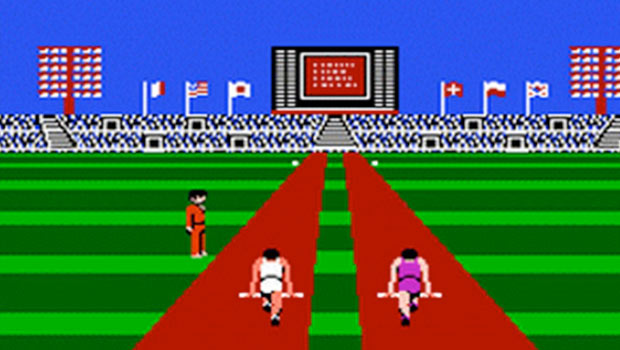
In every phase of videogames' development and (short) history, they've been specifically designed to wow people with what new "magic" computers can do. In fact, the impetus for the creation of what many call the first videogame, Spacewar!, was an attempt to find a way to get people to appreciate the giant computer systems in the basement of MIT. People didn't really understand what computer were for, but videogames helped them realize they were at least useful for something.

And so, every step of computer advancement has been quickly met with a new videogame to show it off. That's how we get this:

2. Art
The art and design of videogames is often meant to inspire awe. The new medium to work with has pushed artists to new limits apart from the graphical capabilities. This is easy to see in videogame concept art (art done before work on the game begins to help solidify a look and feel for the team). Check out these examples:
Batman: Arkham City

Bioshock Infinite
Assassin's Creed IV: Black Flag
3. Skill
If you didn't know, videogames are a sport now. By law. Videogames have bred their own kind of unbelievable skill that--IF you understand what's going on--can totally blow you away. Here's an easy one to understand: beating Super Mario 3 in 11 minutes:


Speed runs are actually a huge and growing eSport in and of themselves, being one of the most popular genres on Twitch.tv, a super rapidly growing videogame live-streaming service where people go to watch other people play videogames (didn't think that was a thing? It's a thing.)

Here's one that's harder to understand, but is a good example to show you just how technical these skills get, and how amazing talented these guys really are. This clip is from Starcraft IIand all you need to know is these guys are controlling every single little blue marine at once:

4. Scope
Games today are mind-blowing because they are huge and hugely detailed. In Grand Theft Auto V, for instance, cars make the cool down tink-tink sound when you turn them off, women get creeped out if you walk too closely behind them for too long as a male character, your shoes make squeak and slosh if they're wet, you can set the settings on your in-game cell phone such as vibrate or ring, others characters will tell you off for calling you back so quickly if you call immediately after finishing a conversation, and one of the main characters Michael will say things you actually just did in the game when he goes to talk to his shrink. Plus, It's an entirely explorable and interactive recreation of not just Los Angeles, but the entire county of San Andreas where you can buy property and stocks, play tennis, go skydiving, go scuba diving, and much, much more.

On top of that, the world of Minecraft, the hugely popular block-building game, is over 9 million times the size of Earth, meaning its practically infinite and may never be completely filled (though if anyone would do it, its Minecraft players.)

5. Participation
Perhaps the most mind-boggling part of vidoegames of all is just how much people play them. It is impossible to get your head around just how much videogame playing is going on in the world.
  • Check out this infographic on League of Legends, the most popular computer game in the world right now with well over 70 million registered users. 
  • Consider that players have spent a collective 6 million years of man-hours playing World of Warcraft, and its wiki is 10% the size of all of the real Wikipedia combined.
  • Just look at this, the entire world of Games of Thrones remade brick by brick inMinecraft, with hundreds of people helping and contractors, subcontractors, and quality controllers organizing the whole thing:
Full article on Wired

These are just my preliminary categories in which videogames inspire the most awe, or aspects that are most often leveraged to try and inspire awe over videogames.

Can you think of any others?

Friday, January 3, 2014

The Mechanic is the Message: Brothers: A Tale of Two Sons


Brothers: A Tale of Two Sons can easily be read as one long setup for a single mechanical trick that takes videogames into a whole new realm of meaning and communication. It's a beautiful game visually and emotionally throughout, but its point--its prestige, if you will--comes all in a single moment at the end of the game. That moment is a kind of mini-manifesto in itself about what videogames can do, and I'd like to take a second here and unpack it.

Warning: REAL SPOILER ALERT. Despite what I have said before about how spoilers can't actually ruin anything, I would highly, highly suggest in this case playing the game for yourself before reading on if you want to get the full experience. The power of Brothers comes not in plot revelation, but in mechanic revelation, and that's a totally different experience. (Incidentally, for those of you on Playstation Plus, this game is free for you at the time of this writing, so definitely go take a look at the game first.)

Last chance.

Okay, for those of you still reading, the moment I was talking about was of course the final river crossing, when the little brother walks up to the water and both he and you realize in a whole new way the pain of the older brother's loss, and have to figure out how to go on without him. The little brother has never been able to swim on his own thanks to his fear of water after their mother drowned, and he had relied on the older brother to carry him through the water every time before. But now older brother is gone and this river is standing between little brother and their father's life--a life made all the more precious now with the loss of both mother and brother. My experience with this scene I'm sure was exactly what the designers wanted. I went forward, pushed the little brother's interaction button, and realized after a couple seconds that that wasn't going to work. I moved around a little bit, tried it again, then stopped and stared at the water for a second while I thought what to do. As an experiment, I tried pushing the older brother's interaction button even though he was dead. Instantly, I was rewarded with the controller rumbling, ghostly whispers, and the little brother bravely diving into the water. I felt instantly the rush of love for what now felt like my own dead brother, and the game expertly lays an ambiguity between simply calling on this older brother through memory and actually receiving help from the brother's deceased spirit. Whether meant to be read metaphorically or literally, I instantly understood that even though older brother was gone, he still mattered in the world of Brothers, and he still influenced the life of his living brother and father. In that one button press, Brothers made me reflect on love, family, death, and life in an entirely new way. In this one moment, Brothers achieved something truly great.

To let you enjoy the sensation, the game lets you use the trick a couple more times in your final push toward the ailing father and the game's conclusion as the little brother draws on the strength of his deceased sibling to pull the lever he could never pull and reach the ladder he could never reach, finally stumbling with exhaustion into the doctor's home to deliver the life-saving liquid to his father.

This one mechanical turn is exactly the kind of moment that proves the unique power videogames have to communicate. It's the exact kind of moment I've been looking for and advocating for. It doesn't give you profound prose or deep dialogue or Oscar-worthy acting, but it does exactly the same thing that makes those things praise-worthy: it successfully transfers a human experience in such a way that it's felt as if it were real, so powerful and piercing that it can never be forgotten. Game writers often make the claim that such-and-such thing that such-and-such game does cannot be done in any other medium, but that claim is often made when a game simply does more than other mediums--like The Last of Us making more connection with its characters than could be possible in film or Bioshock Infinite creating more atmosphere than could be possible a novel. All games are inherently different than other mediums because of the interactive element, and I'm not saying that The Last of Us, Bioshock Infinite, and other games don't use interactivity to communicate, but what Brothers accomplishes with the dead brother mechanic just feels so totally different from anything else, with no analogue in any other medium. It's not that it's just more or better, it's truly different. Yes, other mediums have done ghosts and help from beyond the grave and all that, but I'm not talking about what the story of the game does, I'm talking about what the game itself does in that moment of frustration and that rush of revelation as the player finally pushes the older brother's button. It's a moment where the player must use what they've learned about the systems of the game to advance the story of the game, where suddenly oil and water mix and the game system tells a more powerful story than any of its cut-scenes ever could. It's a moment where gameplay communicates rather than just functions. It's a feat that takes what The Marriage promised to a whole new level. It's one of the best cases yet to show the world that videogames truly can do something different, beautiful, and great.

I've talked a lot about videogames receiving a sense of cultural legitimacy in our society. Many make their case by showing they can do the same things that other mediums do, improved through interactivity. I think that's a good case. But the case Brothers makes is a different case, one that shows the world that with a new medium comes an entirely new way to communicate meaning, and videogame players and designers alike are only just beginning to tap into this new language of expression. This is the case that will ultimately solidify videogames' place in the cultural canon of "great art." More importantly, this is the case that just may wake the world up from its ill-formed and deep-rooted prejudices against this medium as a legitimate medium of real human expression.  This is the best case for the future of videogames, and the one I hope designers the world over continue to pursue.

Tuesday, December 31, 2013

The Mechanic is the Message: The Agents

I've played a lot of games while I've been off from school for a couple weeks. Thanks to Christmas gifts and Kickstarter, I've been able to play a lot of new games with new ideas. One thing that's particularly stood out to me about the games I played over the holidays is how game mechanics can communicate meaning. This is especially true in two games I played this past week: Brothers: A Tale of Two Sons, and the tabletop game The Agents. I'll cover The Agents in this post, and Brothers in the next.


These Cards are People
Let's start with The Agents. The Agents is a "double-edged cards game," a name they apparently trademarked for themselves. The core mechanic of the game, which is explained in their Kickstarter video below, is placing cards either facing you or facing your opponent to get either points or abilities. Abilities help you control the game, but points help you win, so you have to balance the two to succeed.


The Agents is smart in a lot of ways, but specifically it connects its mechanics to its themes better than any other tabletop game I've ever played. The premise is that all these agents have been disavowed by their home governments and are now working rogue, using their skills to whatever ends they see fit. As such, the individual agents' relationships to the player are different than you'd expect in a traditional card game. In most card games, each player has their own cards that serve them faithfully and always give benefit to the player who lays them down. Thanks to the mechanics of this game, though, cards can literally turn on you at a minute, and suddenly these cards aren't slaves to a game, but people--agents with their own agendas.

This is accomplished in two ways. First of all, the Agents breaks the sense of ownership between player and card. Yes, you have cards in your hand, and yes, you play them how you want, but any card you play gives two separate benefits, one to you and the other to someone else. Additionally, you play agent cards on a faction, but no one owns any one faction. Instead, factions are shared between two players, and both players try to influence the faction in such a way that the most advantage goes to them. With cards being "double-edged" and faction control being decentralized, suddenly the agents themselves are players in the game as well.

I've played this game several times now and taught it to 5 or 6 different people. Invariably, there comes a moment in each person's first game where they're holding a card they want to play, just looking from one faction to the next, considering all the implications of each possible placement and direction of the card, and then they'll just stop and blurt out, "Oh, crap." The Agents makes it very difficult to figure out exactly which play is most advantageous to you, and it's also very good at making other players present you with unexpected opportunities as they put points or commands in your direction that you didn't see coming.

Gameplay considerations aside (for now, though seriously that's great game design in itself), I realized in a rush in one game just how well these mechanics combine to represent the game's themes. "These cards are people," I suddenly thought. Rather than serving me like my slaves, the cards in the Agents are characters--skilled agents who have their own agendas and will serve whom they will serve, how they wish to serve them. This effect is enhanced by the extremely careful balance of the cards. It's nearly impossible to get a "mega turn" in The Agents, because each agent only has one ability, and those abilities most often only affect one other card at a time. In this way, the Agents becomes a true tactical game, where you constantly have to look at what's in front of you and consider all the possibilities. All combined, this makes the Agents feel extremely like a tense game of politics and juggling loyalties with real people and real consequences to each decision.

At this point, all the game's subtle puns start coming out. "Double-edged cards" doesn't just mean the mechanic of points and commands, but the duplicitous nature of the agents themselves. "Turn," one of the commands in the game, literally means turn the card around, but it also represents turning loyalties from one player to the other. These and other commands and verbiage in the game serve both gameplay and theme, at times ingeniously.

Games are a language in themselves, and like any language, there are multiple layers of expression going on at once. Functional games present you with mechanics that are understandable and work together well. Good games make those understandable and functional mechanics more robust and complex, and give clever nods to the framing theme of the game to splash in more fun for the players. Great games, though, are like great language: functionally elegant, but exploiting the functions of the language itself to communicate higher-level associations and observations. Great language can be consumed on a functional level without the audience recognizing its subtle greater accomplishments along the way. With a little training and thought and a keen eye, however, great language unpackages its greater meaning as the proper eyes study each bit of functional elegance. The careful study of such language can reveal meanings applicable far beyond the moment of the language itself. Truly great games are also great language--they function properly, but they also make themselves available to extended critical thought that goes beyond the game itself to discussing bigger and broader things.

It is in this sense that the Agents is a great game to me. Functionally, it's genius already, but careful study of the game lends easily and profitably to broader thought and discussion on human nature, ambition, and loyalty, a fact attested to by many a game table dispute as the game heats up,  agents start spinning like tops and the final points come rushing in.

Monday, November 18, 2013

The Romantic Dead


I wrote a little bit last week about my experience with TellTale's The Walking Dead and the rise of what I've come to call "film-games." In that post, I also talked about The Last of Us, another of my favorite games of all time. The two games share a surprising amount of similarities (while feeling like entirely different games), but one that particularly catches my attention is that both are works of Neo-Romanticism.

Thursday, November 14, 2013

Moby Dick, Democracy, Participatory Culture, and Games

"Call me Ishmael," Moby Dick begins, establishing the identity of our narrator for us and giving us an introduction to his character and particular voice as he will be telling us this story for quite a while and we should be comfortable with him. Moby Dick is a book full of strong characters--Queequeg, Ahab, Flask, Starbuck, Stubb--each of these character seem particularly individual and powerful in their own right, just as we feel we "get to know" Ishmael, we can "get to know" the other characters and understand their desires and quirks. However, the story isn't about any one of them, its about (and exists because of) all of them combined.

Not only does Melville craft each of these characters expertly to allow each of them their own voice and personality, but the very form of Moby Dick is broken up into distinctive "voices" of different literary genres. Interrupting Ishmael's regular narrative come dramatic monologues (ch. 37), encyclopedic articles (ch. 32), affidavits (ch. 45), as well as histories, articles, and more. Indeed, Moby Dick is designed on a formal as well as a textual level to break up any overpowering voice. In fact, freedom of speech and choice may arguably be what Moby Dick most values, as the ultimate tragedy of its ending comes from Ahab drowning out everyone else with his power and desire.

Sunday, November 3, 2013

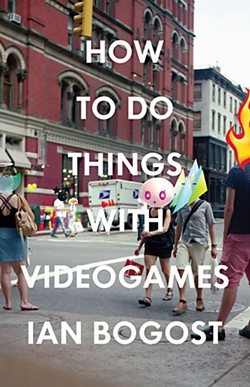
How to Do Things With Videogames by Ian Bogost

How to Do Things With Videogames might not be the book you're expecting it to be. It's not a game How Things Have Been Done With Videogames. As such, it reads more like a highlight reel of Bogost's blog posts on videogames than a single argument that unfolds from chapter to chapter.
design book that discusses technical solutions, neither is it a book of videogame criticism focused on the effectiveness of individual titles. Rather, it's an eye-opener book meant to show anyone and everyone what has been done with videogames so far in their relatively short history. Indeed, a better title for this book might be

Once you understand that purpose of this book, it's easy to see how well that purpose is fulfilled. The examples Bogost provides are varied and plentiful, allowing any curious reader to use the chapter on their topic(s) of choice as a starting point for a deeper study in a specific use of videogames. Rather than settling into the common and heated debate of "videogames as art," Bogost addresses that as simply one use for the medium in this book's first chapter, then moves on to much more varied and surprising uses for videogames, from empathy and kitsch to reverence and exercise.

While the individual chapters do not linearly unfold a single argument, Bogost frames the collection as evidence for one major point he wishes to make. He states this point explicitly in the introduction and conclusion: "We can understand the relevance of a medium by looking at the variety of things it does." The collection of essays that follows this introduction proves this point, which in turn is used to argue his final point in the conclusion: "Soon gamers will be the anomaly. If we're very fortunate, they'll disappear altogether. Instead we'll just find people of all sorts. And sometimes those people will play videogames. And it won't be a big deal, at all."

It may seem contradictory to write a book about videogames just to suggest that the gamer community will die out, but really what Bogost is trying to do is show how games will only continue to increase in use and relevance in our society such that we will no longer consider those who play videogames as some kind of specialized hobbyists. It's an interesting blend of hope and submission that Bogost presents the reader; videogames will indeed continue to grow in scope and legitimacy in society, but at the same time they will lose their edgy appeal and excitement until they become just another medium we interact with.

As Bogost says himself, this is certainly not headline material. It is, however, the most realistic and all-encompassing view of the future of videogames out there. The excitement of videogames as a medium is bound to die down in the coming years as current generations will grow up with them as a fact of daily life. When that happens, the excitement will come from individuals exploring and exploiting videogames' seemingly infinite uses in innovative and provocative ways. Bogost himself has done that elsewhere, but that's not what this book is about. This book is about showing the world videogames are here to stay and inviting us all to accept this new medium like we would any other, then inviting us to get past that and start using videogames as well and as interestingly as we do any other medium of expression.


Friday, November 1, 2013

"Playing" Prospero

This post was originally written for a Shakespeare class blog. See it here.

I've been thinking about my post of "The Tempest: The Video Game" and my point at the end about how the player could play Prospero and be forced to enslave Caliban as a new way to interpret the themes of the play. There's something much bigger in that idea than I thought at first.

Clint Hocking, an influential game designer, was quoted in the New Yorker in 2011 as saying,


Clink Hocking's online avatar
"Finding a way to make the mechanics of play our expression as creators and as artists—to me that’s the only question that matters." 

Like my suggestion in my post, he was talking about how the mechanics of the game could enhance the art of the author and designer. However, in a post on his blog he altered this quote ever-so-slightly but importantly to say, 


"Finding a way to make the dynamics of play support the creative expression of players—to me that’s the only question that matters."


A lot of the art of theatre comes from actors coming up with new interpretations for characters, or in the subtle differences a certain actor gives to a script by the way they he or she plays it. Why can't it be the same with video games? Taking that same scenario from above, a player could choose to try and avoid enslaving Caliban, or that same player could enslave Caliban the second he/she meets him, before the reasons to enslave him are even clear. Just like an actor or actress, the gamer could "play" Prospero however he/she chooses.


That's good art.